The framework that we used to build a predictive model for regression followed four distinct steps:
- Decide on the mathematical form of the model: we used a linear model with potential for transformations and polynomials
- Select a metric that defines the “best” fit: we used \(R^2\) or \(\text{MSE}\)
- Estimating the coefficients of the model that are best using the training data: we found the coefficients that minimized our metric of choice on the training data
- Evaluating predictive accuracy using a test data set: we calculated testing \(R^2\)/\(\text{MSE}\) using ~20% of the data that was withheld
We used this process to build our first simple linear regression model to predict high school graduation rates but the same four steps are used by Zillow to build ZestimateTM, their deep learning model to predict house price.
These are also the same four steps that we will use as we shift in these notes to the task of classification. In a classification task, we seek to predict a response variable that is categorical, very often a two-level categorical variable. Classification models are everywhere: they help doctors determine whether or not a patient has a disease, whether or not an image contains a particular object (say, a person or a cat), and whether or not customer will purchase an item.
Example: Spam filters
Email spam, also referred to as junk email or simply spam, is unsolicited messages sent in bulk by email (spamming). The name comes from a Monty Python sketch in which the name of the canned pork product Spam is ubiquitous, unavoidable, and repetitive. A spam filter is a classification model that determines whether or not a message is spam based on properties of that message. Every mainstream email client, including Gmail, has a spam filter built in to ensure that the messages that get through to the user are genuine messages.
The Data
In order to build a spam filter, we’ll need a data set to train our model on. This data set must have as the unit of observation a single email message, record whether or not the message was spam (the response), and record various features of the message that are associated with being spam (the predictors). Such a data set, with nearly 4000 observations, can be found in the email data frame in the openintro library.
# A tibble: 3,921 × 21
   spam  to_multiple from     cc sent_email time                image attach
   <fct> <fct>       <fct> <int> <fct>      <dttm>              <dbl>  <dbl>
 1 0     0           1         0 0          2012-01-01 06:16:41     0      0
 2 0     0           1         0 0          2012-01-01 07:03:59     0      0
 3 0     0           1         0 0          2012-01-01 16:00:32     0      0
 4 0     0           1         0 0          2012-01-01 09:09:49     0      0
 5 0     0           1         0 0          2012-01-01 10:00:01     0      0
 6 0     0           1         0 0          2012-01-01 10:04:46     0      0
 7 0     1           1         0 1          2012-01-01 17:55:06     0      0
 8 0     1           1         1 1          2012-01-01 18:45:21     1      1
 9 0     0           1         0 0          2012-01-01 21:08:59     0      0
10 0     0           1         0 0          2012-01-01 18:12:00     0      0
# ℹ 3,911 more rows
# ℹ 13 more variables: dollar <dbl>, winner <fct>, inherit <dbl>, viagra <dbl>,
#   password <dbl>, num_char <dbl>, line_breaks <int>, format <fct>,
#   re_subj <fct>, exclaim_subj <dbl>, urgent_subj <fct>, exclaim_mess <dbl>,
#   number <fct>
We see in the left most column the response variable, spam, coded as 0 when a message is not spam and 1 when it is. The first predictor, to_multiple, is a 1 if the message was sent to multiple people and 0 otherwise. cc records the number of people who are cc’ed on the email. winner (listed as a variable below the glimpse of the dataframe) records whether or not the word “winner” showed up in the message. The remaining predictors you may be able to intuit by their names, but you can also read the help file that describes each one.
These variables seem like they might be useful in predicting whether or not an email is spam, but take a moment to consider: how were we able to get our hands on data like this?
This particular data set arose from selecting a single email account, saving every single messages that comes in to that address over the course of a month, processing each message to create values for the predictor variables, then visually classifying whether or not the message is spam. That’s to say: this data represents a human’s best effort to classify spam. Can we build a model that will be able to identify the features that mark a message as spam to be able to automatically classify future messages?
Exploratory Data Analysis
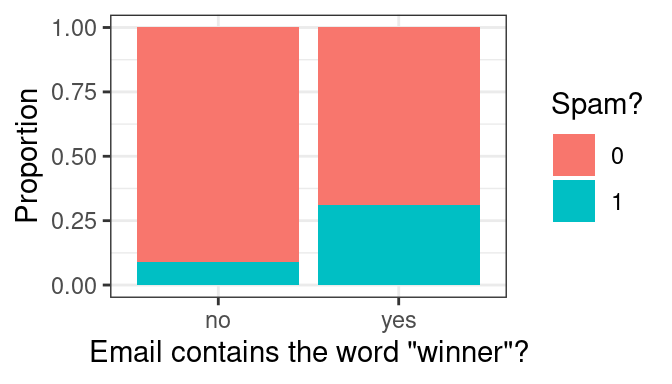
Let’s see how well a few tempting predictors work at separating spam from not spam by performing some exploratory data analysis. We might expect messages containing the word “winner” to be more likely to be spam than those that do not. A stacked, normalized bar chart can answer that question.
Indeed, it looks like around 30% of emails with “winner” were spam, compared to roughly 10% of those without. At this point, we could consider a very simple spam filter: if the message contains “winner”, then classify it as spam.
Although this is tempting, it is still a pretty weak classifier. Most of the messages with “winner” are not spam, so calling them spam will result in most of them being misclassified.
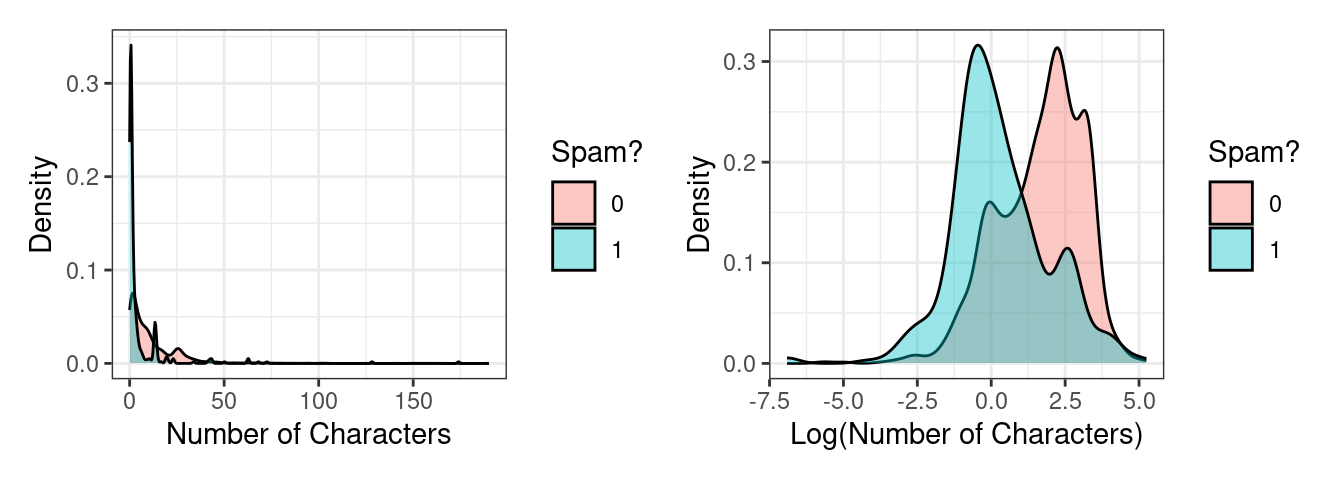
So if “winner” isn’t the silver bullet predictor we need, let’s try another: num_char. This variable records the total number of characters present in the message (in thousands) – how long it is. We probably have no prior sense of whether spam would be more likely to consist of short or long emails, so let’s visualize them. This predictor is numerical continuous, so let’s overlay two density plots to get a sense of the distribution between spam and not spam.
The original plot on the left is very difficult to read because this variable is heavily right-skewed: there are a small number of very long messages that obscure much of the data in the plot. On the right is a more useful visualization, one of the log-transformed version of the same variable.
We see a reasonable separation here: spam messages tend to be shorter than non-spam messages. We could consider another very simple spam filter: if the log number of characters is less than 1.2, classify it as spam.
However, this simple filter suffers from the same problem as the first. Although these density plots have the same area, there are in fact far fewer overall instances of spam than not-spam. That means that there are far more not-spam messages with a log number of characters less than 1.2 than there are spam message. This filter, like the first, would misclassify much of the training data.
What we need is a more general framework to fold the strength of these two variables - as well as many of the other ones in the data set - into a model that can produce a single, more accurate prediction. We will start from the framework of multiple linear regression and move to something that can be used for classification.
From Linear to Logistic Regression
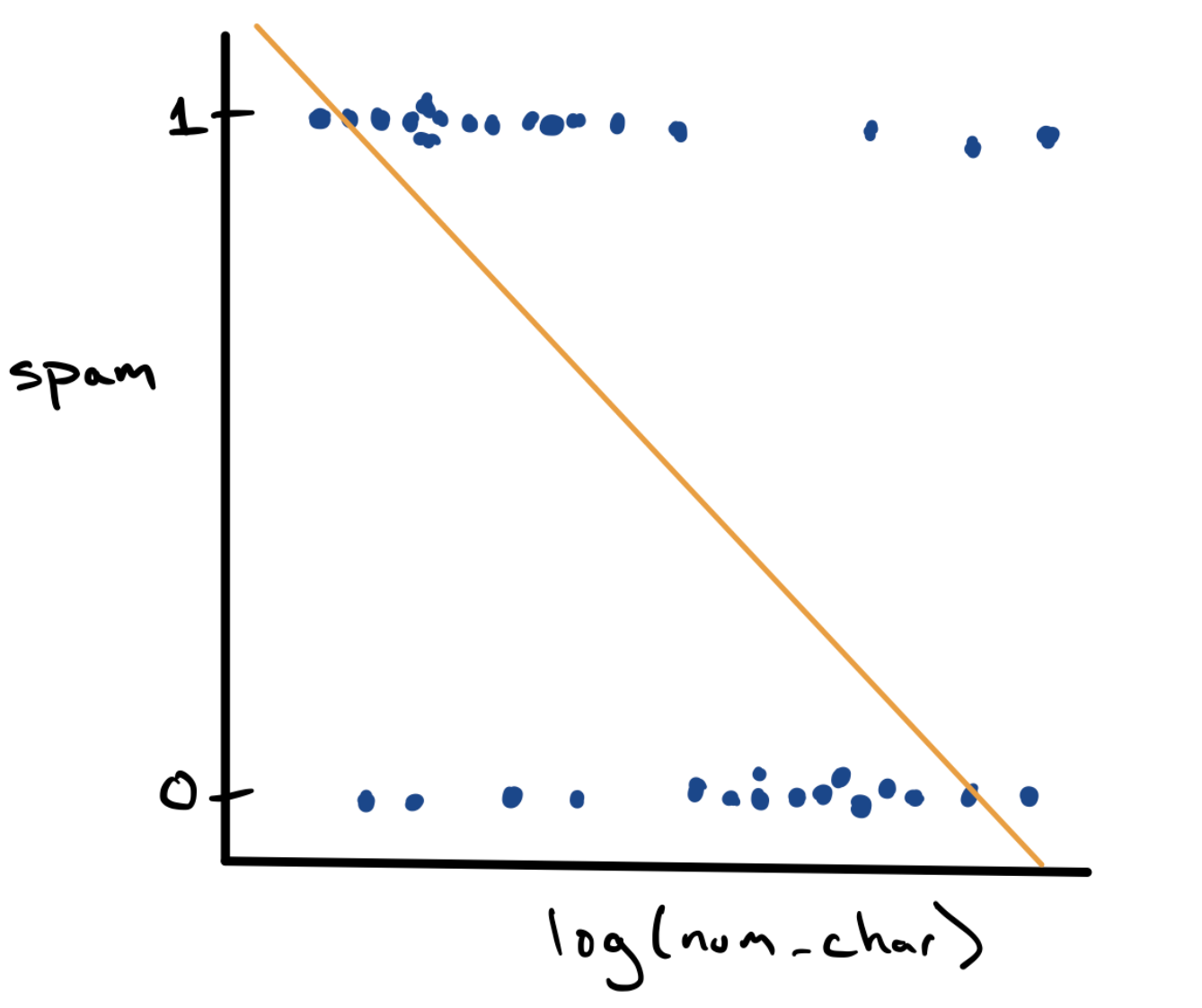
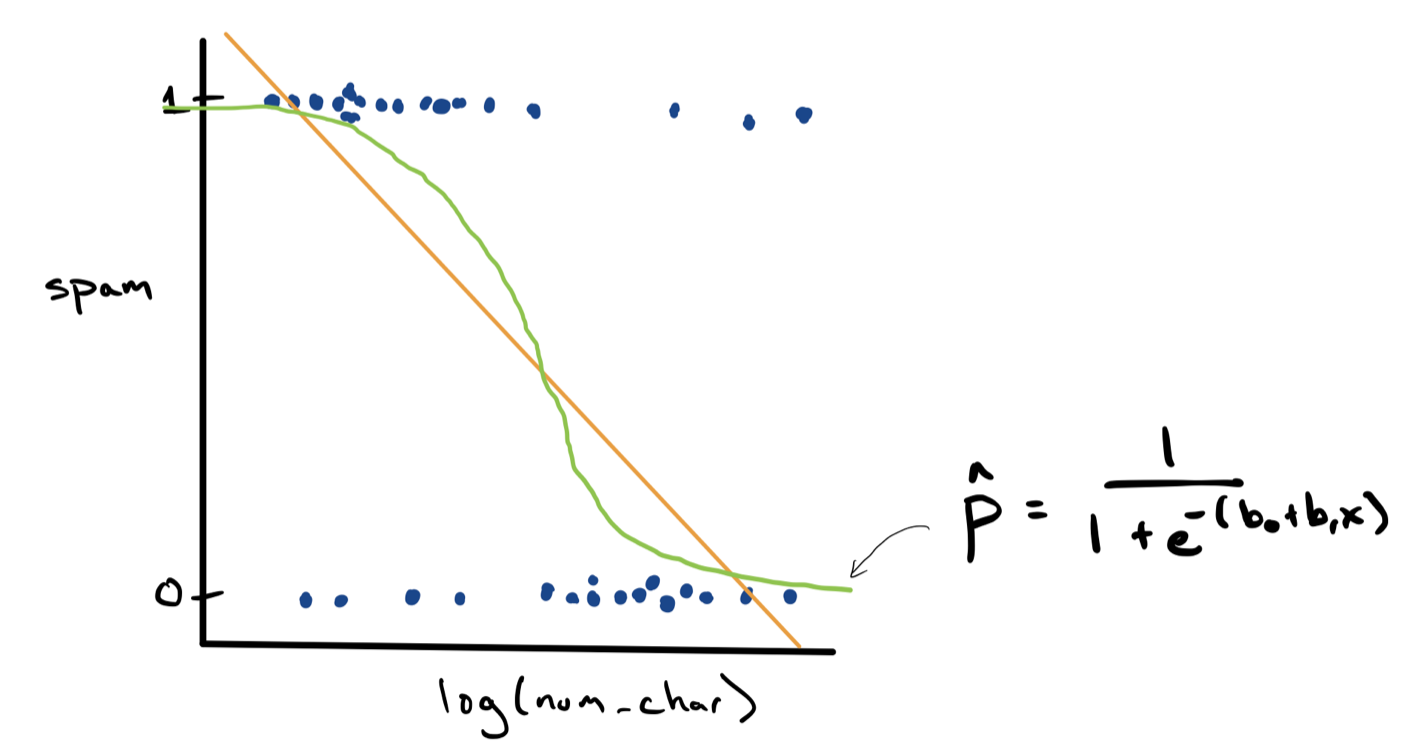
Let’s start by taking our existing simple linear regression model from the past few notes and applying it in this classification setting. We can visualize the relationship between log_num_char and spam using an ordinary scatter plot.
This is a strange looking scatter plot - the dots can only take y values of 0 or 1 - but it does capture the overall trend observed in the density plots, that spam messages are longer. Since we have a scatter plot, we can fit a simple linear regression model using the method of least squares (in gold).
\[ \hat{y} = b_0 + b_1 x \]
While this is doable, it leaves us with a bit of a conundrum. For a low value of log_num_char it’s possible that we would predict \(\hat{y} = 1\) and for a high value it’s possible that we’d predict \(\hat{y} = 0\). But what if log_num_char is somewhere in the middle? What does it mean if we predict that the value of spam is .71?
One approach to resolving this is to treat our prediction not as a value of \(y\), but as a estimate of the probability, \(\hat{p}\), that \(y = 1\). We can rewrite the model as:
\[ \hat{p} = b_0 + b_1 x \]
This resolves the conundrum of how to think about a prediction of .71. That is now the model’s determination of the probability that the message is spam. This tweak solves one problem, but it introduces another. How do we interpret predictions at very high values of log_num_char, where \(\hat{p}\) is negative? Surely a probability cannot be negative!
We can fix this by changing the mathematical form of the model used to predict the response. Instead of it being a line, we can use an alternative function that prevents predictions greater than 1 and less than zero. The most commonly used function is called the standard logistic function:
\[ f(z) = \frac{1}{1 + e^{-z}}\]
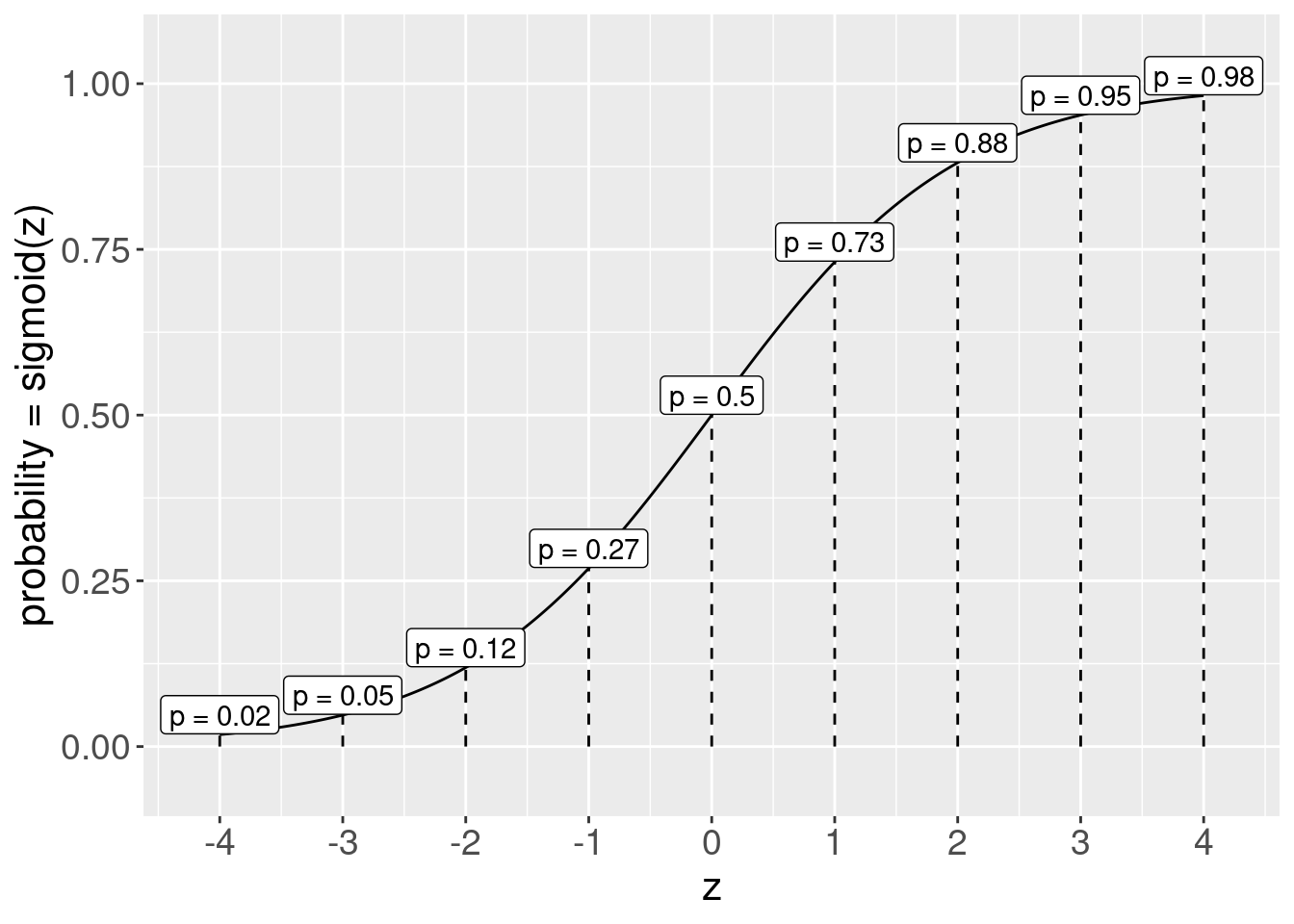
\(z\) can be any number of the real number line. As \(z\) gets large, \(f(z)\) approaches 1; as \(z\) is negative, \(f(z)\) approaches 0; when \(z\) is 0, \(f(z)\) is .5. Let’s build some intuition here:
| 0 |
\[\frac{1}{1 + e^{0}}\] |
\[= \frac{1}{1 + 1} = 1/2\] |
| -1 |
\[\frac{1}{1 + e^{1}}\] |
\[= \frac{1}{1 + e} = \frac{1}{1 + 2.72} \approx 0.27\] |
| 1 |
\[\frac{1}{1 + e^{-1}}\] |
\[= \frac{1}{1 + 1/e} = \frac{1}{1 + 0.368} \approx 0.73\] |
| -1,000,000 |
\[\frac{1}{1 + e^{1,000,000}}\] |
\[\approx \frac{1}{1 + \infty} \approx \frac{1}{\infty} \approx 0\] |
| 1,000,000 |
\[\frac{1}{1 + e^{-1,000,000}}\] |
\[= \frac{1}{1 + 1/e^{1,000,000}} \approx \frac{1}{1 + 0} \approx 1\] |
And here’s a graph of the sigmoid, showing what probability will be predicted based on the z value (the linear part of our model)
This is a very clever idea. It allows us to combine all of the information from our predictors into a single numerical score, \(z\). We can obtain \(z\) through a form that is familiar to us: \(b_0 + b_1 x_1 + \ldots + b_p x_p\). This score can then be sent through the logistic function to estimate the probability that \(y = 1\). This method is called logistic regression.
- Logistic Regression (for prediction)
-
A model to predict the probability that 0-1 response variable \(y\) is 1 using the inverse logit of a linear combination of predictors \(x_1, x_2, \ldots, x_p\).
\[ \hat{p} = \frac{1}{1 + e^{-\left(b_0 + b_1 x_1 + \ldots + b_p x_p\right)}} \]
Can be used as a classification model by setting up a rule of the form: if \(\hat{p}_i\) > threshold, then \(\hat{y}_i = 1\).
We can visualize the approach that logistic regression takes by sketching the predictions as a green s-shaped curve on top of our scatter plot.
Classification errors
Now that we have a model archetype to move forward with, we are almost ready to build it and see how it does. First though, we should first consider what happens when our predictions are wrong. Hopefully, we will classify most of our e-mails correctly, but we will fail at least some of the time. We might predict that an e-mail is spam when it is not. In other cases, we might predict that an e-mail is not spam when it actually is. Therefore, there are two types of error we should consider.
Recall that based on the email dataset, 1 refers to an e-mail which is truly spam. In a binary classification problem, we often call 1 a positive result. Likewise, 0 refers to an e-mail which is genuine. We call 0 a negative result. This sets up formal definitions for the two types of errors mentioned above.
- False Positives
-
Predicting a 1 that is in fact a 0
- False Negatives
-
Predicting a 0 that is in fact a 1
Misclassification rate
While thinking about failing is not exciting, it does give us a way to think about how well our classification model is doing. We would like the number of misclassifications over a large number of e-mails to be as small as possible. This fraction can be quantified as the misclassification rate or \(\text{MCR}\) for short.
Misclassification Rate
\[\text{MCR} = \frac{\text{no. FP} + \text{no. FN}}{\text{no. of predictions}} = \frac{\text{no. of misclassifications}}{\text{no. of predictions}}\]
Just like in a multiple linear regression context, we can fit a suite of different models on the training set and evaluate their performance on the testing set. Now, our model type of choice is logistic regression and our evaluation metric is \(\text{MCR}\).