05:00
Improving Predictions and Overfitting
Which of the following models looks most impressive to you?
(notice that \(Y\) is measured in meters, m)
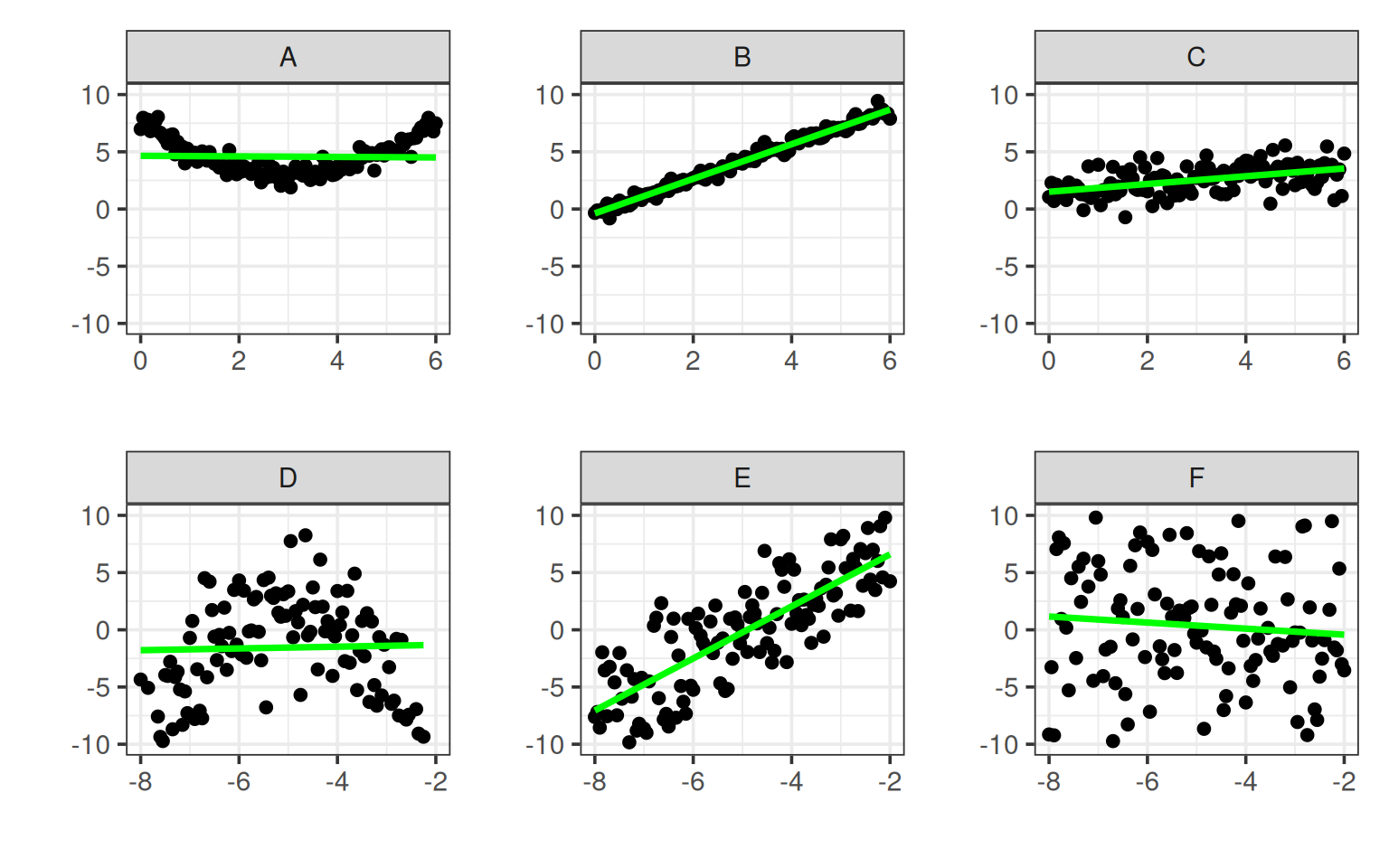
I’d say B is definitely the best but what’s after that?
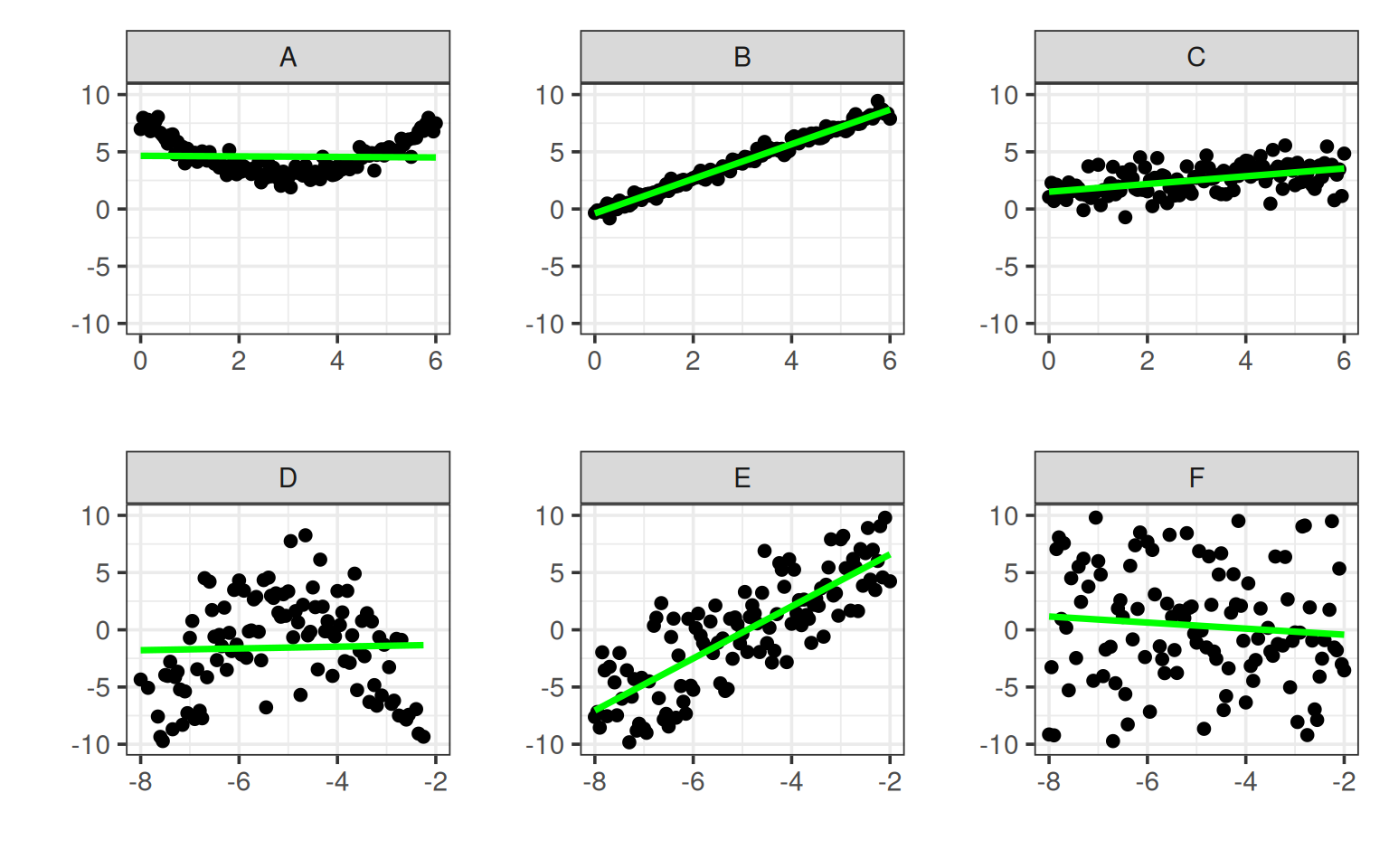
Eyeball the sample RMSE and then MSE of the models.
| Case | RMSE | MSE | Case | RMSE | MSE | Case | RMSE | MSE |
|---|---|---|---|---|---|---|---|---|
| A | \(\approx 2 \mbox{ m}\) | \(\approx 4 \mbox{ m}^2\) | B | \(\approx 1 \mbox{ m}\) | \(\approx 1 \mbox{ m}^2\) | C | \(\approx 2 \mbox{ m}\) | \(\approx 4 \mbox{ m}^2\) |
| D | \(\approx 5 \mbox{ m}\) | \(\approx 25 \mbox{ m}^2\) | E | \(\approx 3 \mbox{ m}\) | \(\approx 9 \mbox{ m}^2\) | F | \(\approx 6 \mbox{ m}\) | \(\approx 36 \mbox{ m}^2\) |
If you must be more accurate…
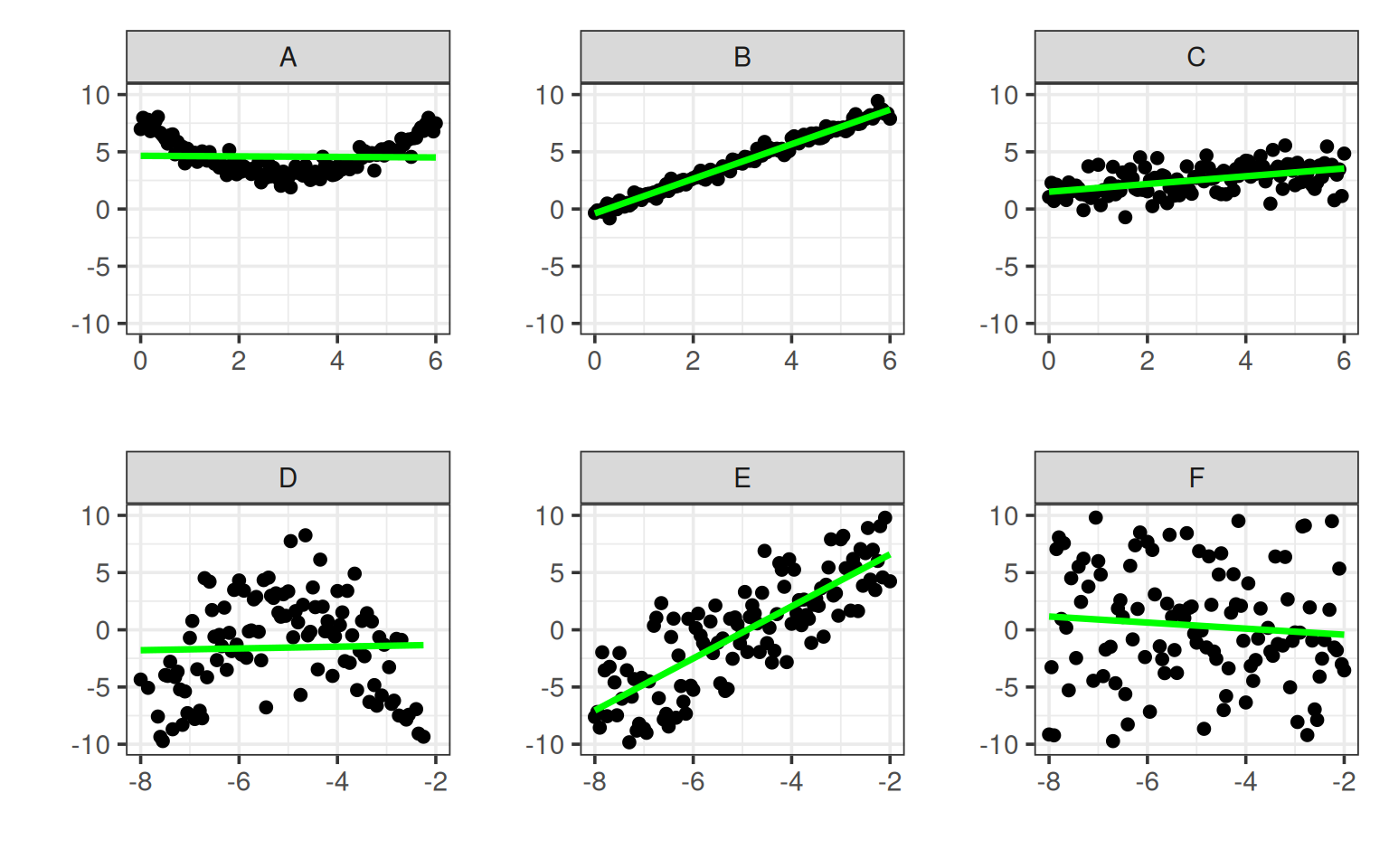
Eyeball the \(Y\)-variances of the samples (i.e. the MSE of the baseline models).
| Case | \(\mbox{MSE}_\mbox{baseline}\) | Case | \(\mbox{MSE}_\mbox{baseline}\) | Case | \(\mbox{MSE}_\mbox{baseline}\) |
|---|---|---|---|---|---|
| A | \(\approx 2^2=4 \mbox{ m}^2\) | B | \(\approx 3^2=9 \mbox{ m}^2\) | C | \(\approx 2^2 = 4 \mbox{ m}^2\) |
| D | \(\approx 5^2=25 \mbox{ m}^2\) | E | \(\approx 5^2=25 \mbox{ m}^2\) | F | \(\approx 6^2=36 \mbox{ m}^2\) |
Or, more accurately…
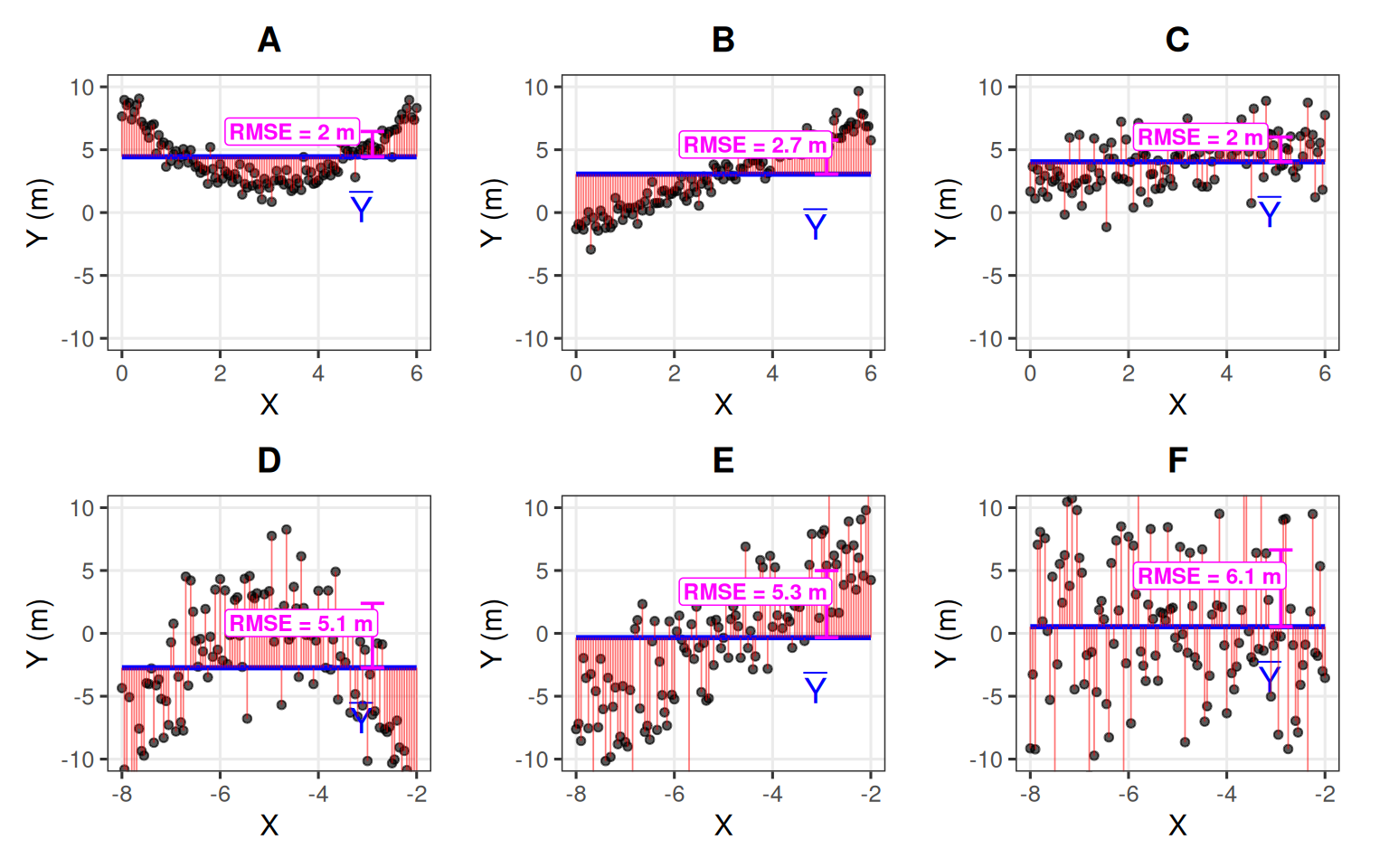
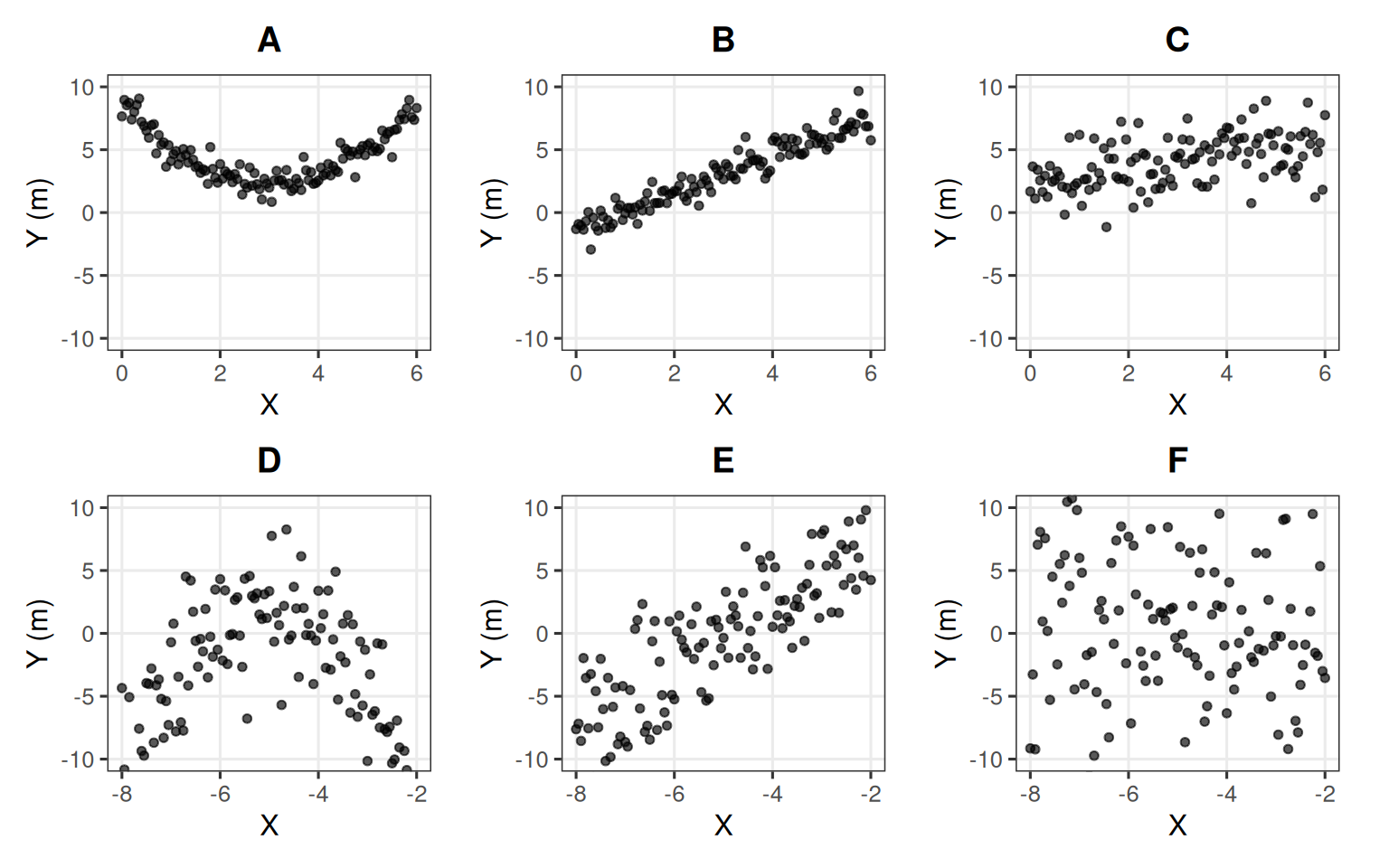
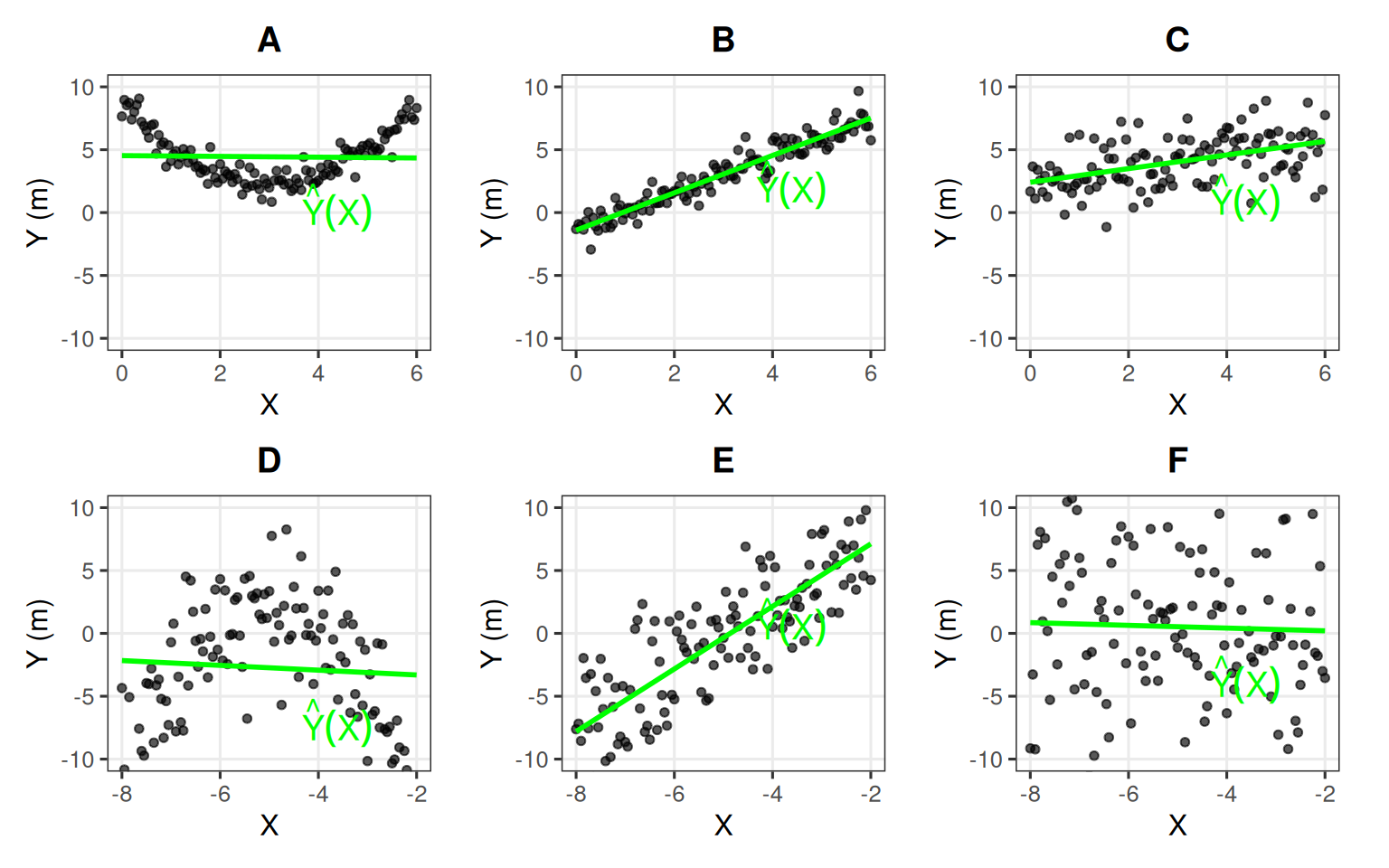
And finally the \(R^2\) are?
| Case | \(R^2\) | Case | \(R^2\) | Case | \(R^2\) |
|---|---|---|---|---|---|
| A | \(\approx 1- \frac{4\mbox{ m}^2}{4\mbox{ m}^2} = 0\) | B | \(\approx 1-\frac{1 \mbox{ m}^2}{9 \mbox{ m}^2} \approx 0.89\) | C | \(\approx 1- \frac{4\mbox{ m}^2}{4\mbox{ m}^2} = 0\) |
| D | \(\approx 1- \frac{25\mbox{ m}^2}{25\mbox{ m}^2} = 0\) | E | \(\approx 1- \frac{9 \mbox{ m}^2}{25 \mbox{ m}^2} = 0.64\) | F | \(\approx 1- \frac{49\mbox{ m}^2}{49\mbox{ m}^2} = 0\) |
The models in A, C, D, F just don’t really do much better than baseline at all…
A and D because the function is bad. Choose a nonlinear function next time! C and F just seem to have no interesting structure at all in them, it’s just useless data…
Did you notice?
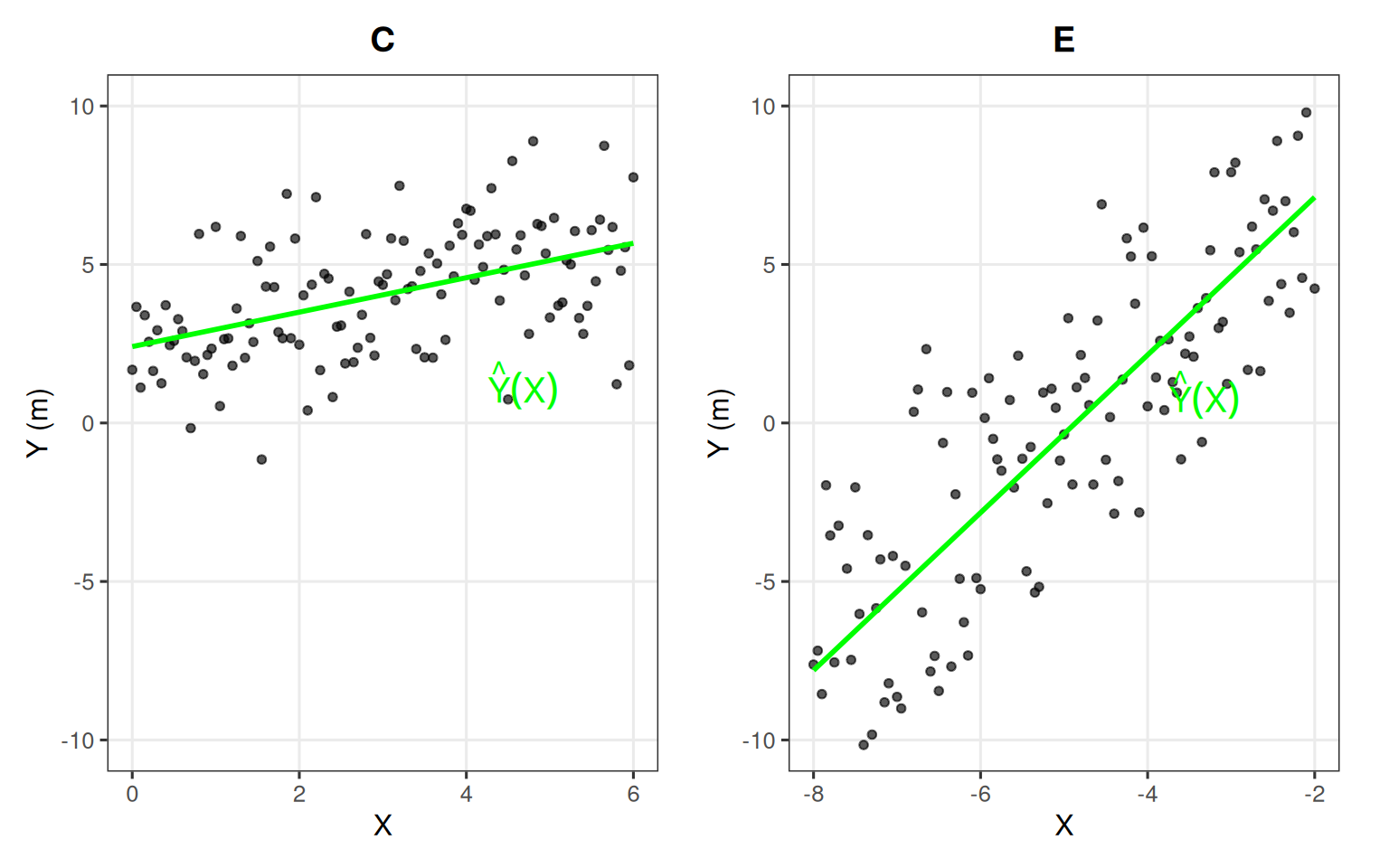
\(\mbox{RMSE}_C \approx 2 \mbox{ m} < 3 \mbox{ m} \approx \mbox{RMSE}_E\) but… \(R^2_C \approx 0 \ll 0.64 \approx R^2_E\)
Did you notice?
\(\mbox{RMSE}_C \approx 2 \mbox{ m} < 3 \mbox{ m} \approx \mbox{RMSE}_E\) but… \(R^2_C \approx 0 \ll 0.64 \approx R^2_E\)
- The model in C makes smaller errors than E in absolute terms.
- But the model in E improves much more over the baseline!
- The model in C is almost useless.
Concept question
- Using
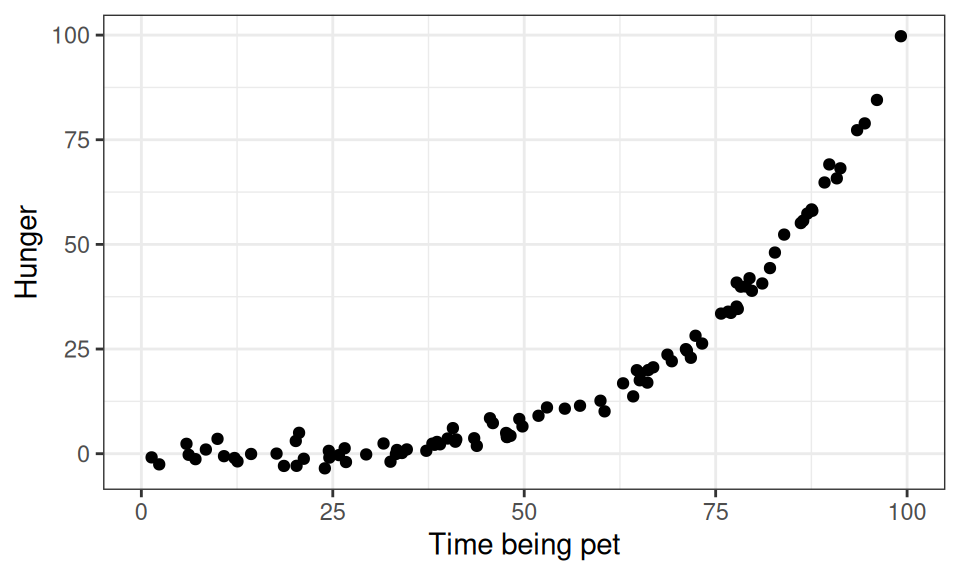
time_being_pet, whichlmformula is most appropriate to predict hunger, based on the below visualization?
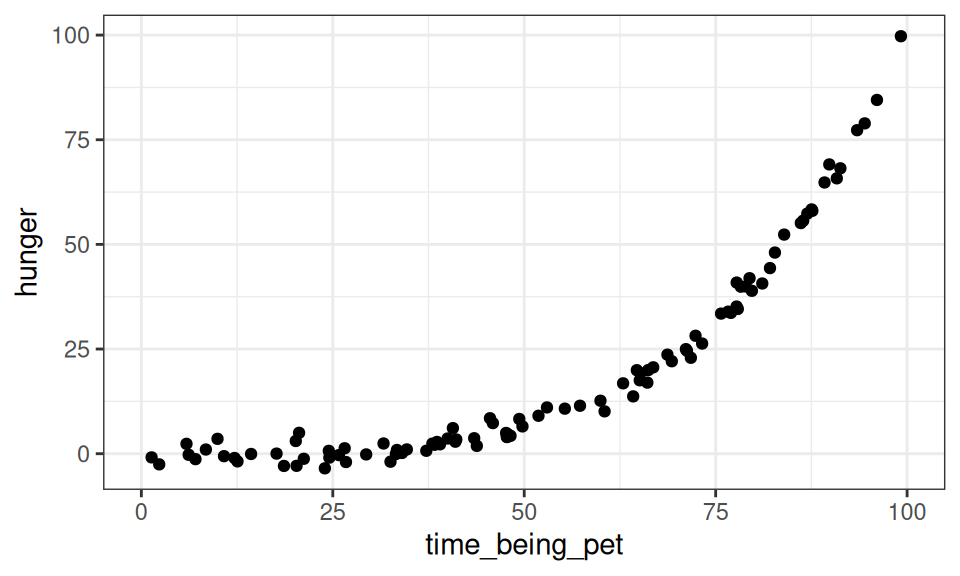
formula = hunger ~ I(time_being_pet^2). Careful! poly(time_being_pet, degree = 2, raw = TRUE) wouldn’t be equivalent. Why?