# A tibble: 1 × 3
   xbar    sx     n
  <dbl> <dbl> <int>
1 116. 78.4 36Confidence Intervals
STAT 20: Introduction to Probability and Statistics
Warmup Questions
95% Confidence Interval for Population Mean
What is an approximate 95% confidence interval for the mean air time in flights using the normal curve?
\[ 115.75 - 1.96 \times 78.3962 / \sqrt{36}, \ 115.75 + 1.96 \times 78.3962 / \sqrt{36} \]
95% Confidence Interval for Population Proportion
# A tibble: 1 × 2
  p_hat     n
  <dbl> <int>
1 0.143    49
What is an approximate 95% confidence interval for the proportion of United Airlines flights using the normal curve?
\[ 0.143 - 1.96 \sqrt{\frac{0.143 * (1 - 0.143)}{49}}, \ 0.143 + 1.96 \sqrt{\frac{0.143 * (1 - 0.143)}{49}} \]
Increasing Precision
You would like to estimate a population mean using a simple random sample of \(n\) observations.
What sample size would you need to increase the precision of your estimate by approximately \(3x\) compared to the original sample?
- \(n + 3\)
- \(3n\)
- \(n + 6\)
- \(6n\)
- \(9n\)
Concept Questions
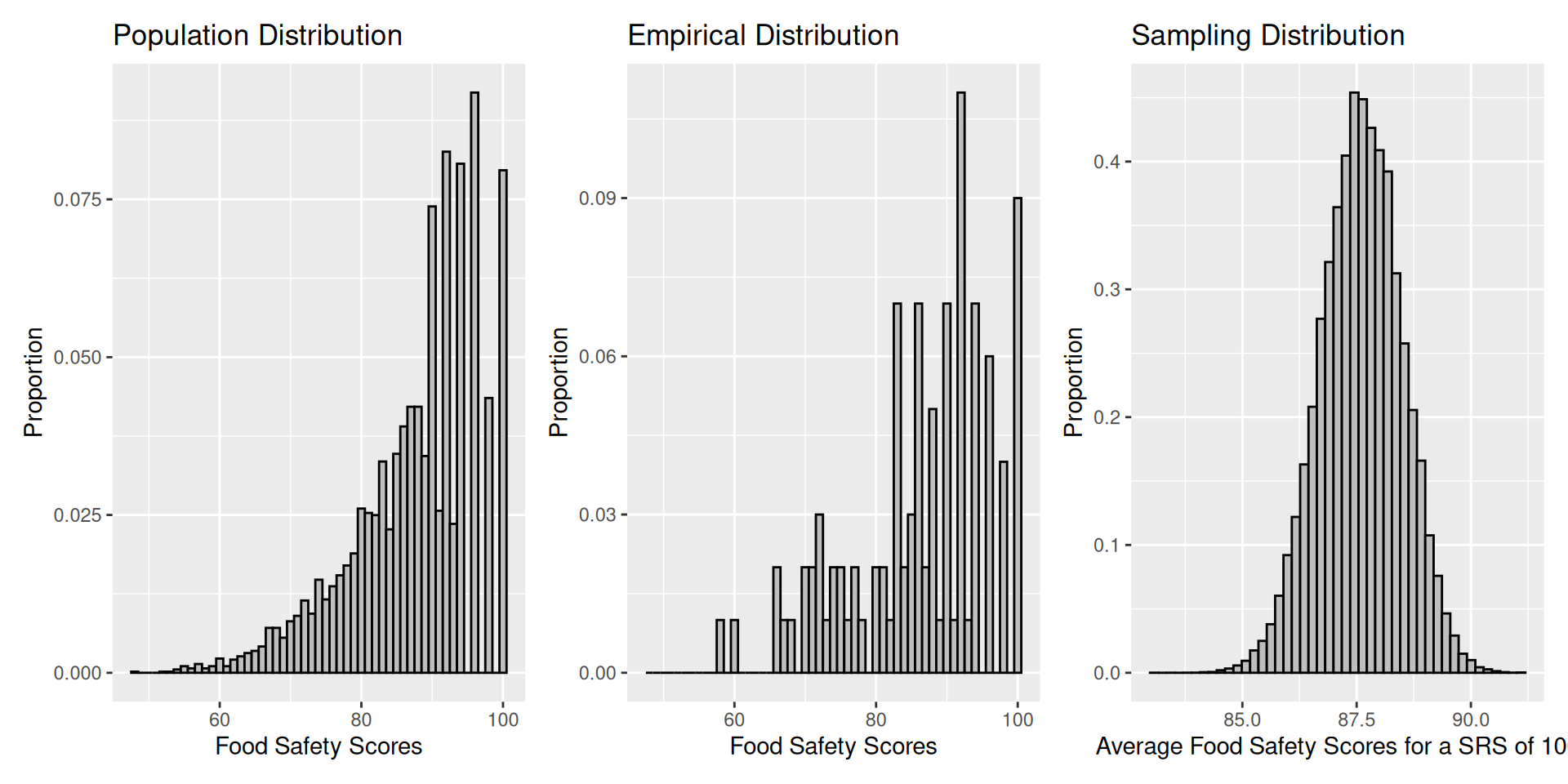
What will happen to the shape of the empirical distribution as we increase \(n\)?
01:00
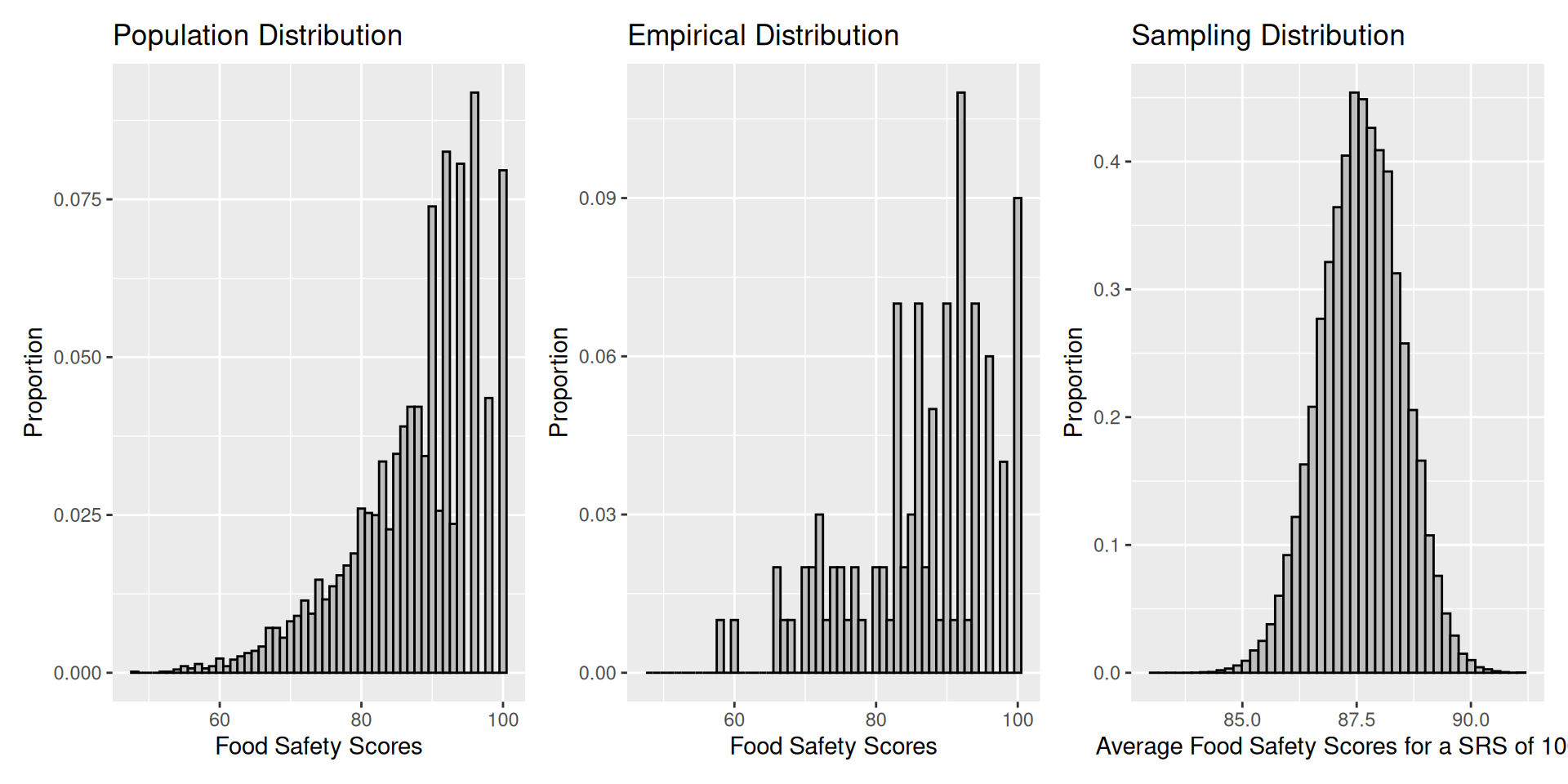
What will happen to the shape of the sampling distribution as we increase \(n\)?
01:00
An economist aims to estimate the average weekly cost of groceries per household in two cites: Oakland, CA (population ~400,000) and Fremont, CA (population ~200,000). Both of these populations of households are presumed to have a similar standard deviation of weekly grocery costs. The economist takes a simple random sample (without replacement) of 100 households from each city, records their costs, and computes a 95% confidence interval for the average weekly cost.
Approximately how much wider would Oakland’s confidence interval be than Fremont’s?
01:00
An economist aims to estimate the average weekly cost of groceries per household in two cites: Grimes, CA (population ~400) and Tranquility, CA (population ~800). Both of these populations of households are presumed to have a similar standard deviation of weekly grocery costs. The demographer takes a simple random sample (without replacement) of 100 households from each city, records their costs, and computes a 95% confidence interval for the average weekly cost.
Approximately how much wider would Tranquility’s confidence interval be than Grimes’s?
01:00
Worksheet: Confidence Intervals
20:00
Break
05:00
Lab 8: People’s Park
25:00